
Blogs

How it Works: Supplier Sub-Tier Visibility

Published: 23 September 2026

The value of monitoring sub-tier risk

In the Hype Cycle for Multienterprise Solutions, 2026, Gartner notes that multitier supplier visibility helps companies increase supply chain resilience and acts as a competitive differentiator. This is because multitier or sub-tier visibility to uncover compliance risks and potential disruptions deep within their supply networks. Companies use this enhanced oversight to adapt to changing market conditions, such as regulations or trade restrictions. They are also better placed to respond to changing consumer expectations.

However, multitier supplier visibility is not enough in and by itself.

The companies that get the greatest value from sub-tier mapping are those that have a clear idea of what they are trying to achieve and why. They have one or more use cases first. The multitier mapping is done in support of those initiatives.

Some of the most valuable and important use cases for multitier mapping are as follows:

  • Expose material and regional concentration risks that remain hidden when multiple direct suppliers depend on the same upstream supplier, material source, or geography.
  • Act earlier on disruptions by identifying sub-tier risks weeks or months before they affect operations, inventory, or customer commitments.
  • Strengthen compliance and responsible sourcing by identifying potential ESG, sanctions, forced labor, and UFLPA exposure deeper in the supply network.
  • Cost optimization by uncovering tariff exposure and uncovering sub-tier suppliers that warrant a direct relationship.

We will now look at these in more detail.

What are the multitier mapping use cases?

Material dependencies and concentration risk identification

Mapping your sub-tier suppliers helps you to assess your risk exposure. This will give you visibility into how sub-tier risks could cascade through your network and impact your operations.

For example, you could have three Tier-1 suppliers in different countries for a critical product. However, if all three suppliers purchase this product, or the raw material needed to make it, from the same sub-tier supplier, you have a serious material dependencies risk.

Any event that disrupts this sub-tier supplier will impact your production. But since you were not aware that this supplier was in your supply network, you will not be aware of the risk until it is too late to get ahead of it.

Concentration risk is similar. Your suppliers may not necessarily use the same sub-tier supplier, but they could be sourcing from the same region. That means a region-wide event, such as a hurricane, could impact your supply chain. Again, you were unaware that you were dependent on this region; you are unaware of the risk until it impacts you.

Sub-tier risk alerting

Sub-tier risk alerting gives you weeks or months to tackle a supplier issue before it impacts your operations.

Since around half of all supply chain disruptions originate in the sub-tiers, early visibility into problems gives you a first-mover advantage.

For example, most companies keep around 30 days of buffer stock in inventory. Therefore, knowing about a risk at a Tier-3 supplier could give you as much as 2 months to tackle a disruption deep within your network.

This is particularly useful if an incident has the possibility of impacting an entire industry or region.

For example, if you know that your Tier-2 supplier has experienced a disruption, you can alert your Tier-1 supplier and mitigate the issue together. For example, since you warned your Tier-1 supplier of the problem, they may agree to prioritize your supply lines.

A bonus is that sub-tier visibility can foster trust and transparency across your supplier network.

Compliance and ESG concerns

Sub-tier mapping can help you uncover sub-tier suppliers that violate compliance laws or your own ESG mandates.

Compliance violations can result in fines, penalties, and damage to your reputation. This in turn can impact your share price and profitability.

The same is true for unethical practices, including forced labor, sanctions, and environmental red flags. ESG compliance does not have to be burdensome. Sub-tier mapping allows you to see potential risks and drive responsible sourcing. This is a competitive advantage that helps build customer trust and brand loyalty.
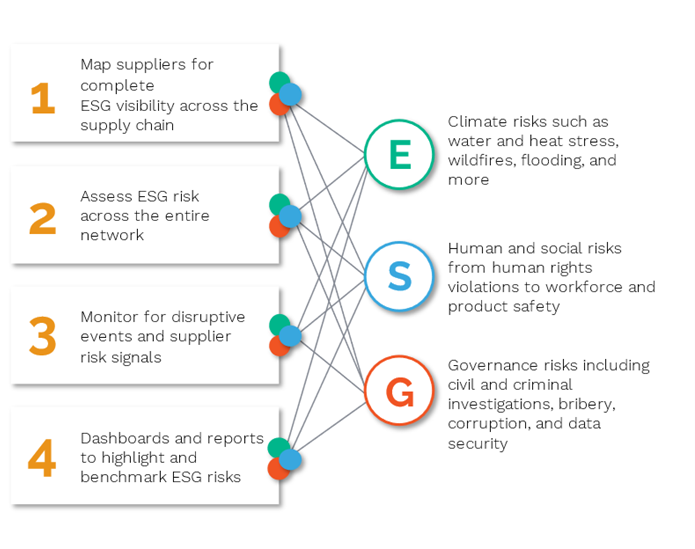
Graphic showing how sub-tier visibility supports ESG monitoring and compliance.

Figure 2: Supplier sub-tier mapping uncovers hidden ESG risks deep within your supply chain.

Cost optimization

Sub-tier mapping can help with cost optimization by helping you uncover tariff exposure and trade policy changes.

While you may not be able to not effect changes to tariff rates, you can clearly see their cost impacts. If you have more than one qualified supplier, you may be able to slowly shift spend to suppliers whose countries have more favorable tariff rates.

In addition, sub-tier mapping can help you identify if there are Tier-2 or Tier-3 suppliers that warrant a direct relationship. This will help you cut costs by eliminating the middleman.
Supply Chain Risk Insights

Explore how Everstream Analytics helps supply chain teams contextualize fast-moving threats.

Get the report

How does Everstream Analytics supplier sub-tier mapping work?

Everstream Analytics Sub-Tier Visibility applies advanced AI and data science algorithms to uncover supplier relations. These are applied to a number of different data sources, including:

  • Trade intelligence: This includes both public and proprietary trade data to uncover supplier relationships beyond Tier-1.
  • Shipment tracking: Shipment data analysis reveals material flows and dependencies across supply chains
  • Geo-positional insights: Specialized data that helps uncover intra-country or trade-zone connections that are typically missed by traditional methods.

While AI drives the initial results, human subject matter expertise validates the results.

This human-in-the-loop approach removes irrelevant results. For example, your supplier could have a longstanding commercial relationship with the company that supplies janitorial services to their location. However, this is not a relationship relevant to your supply chain.

AI can take a huge amount of work out of the sub-tier mapping process, but human judgement is also critical.

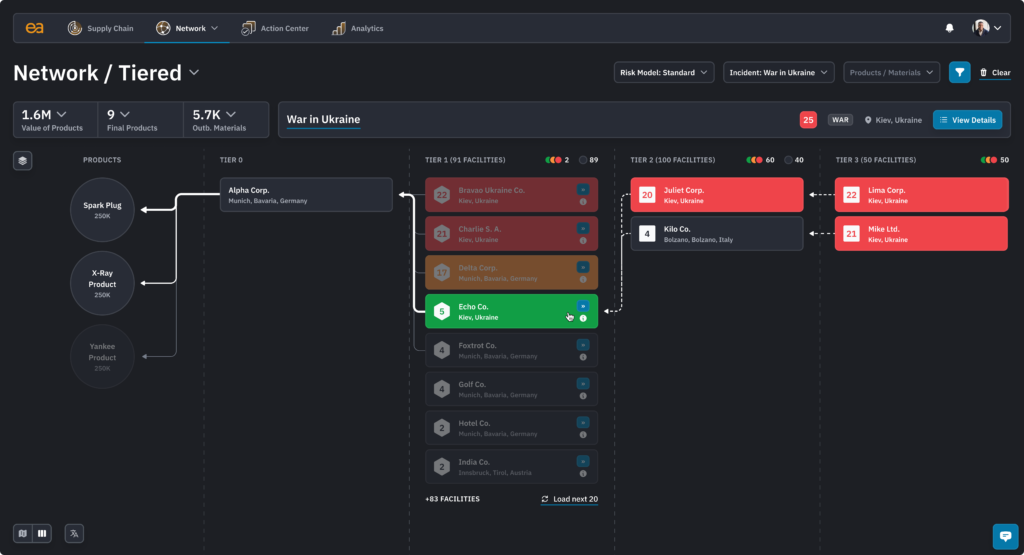
Screenshot of the Everstream Analytics Sub-Tier Visibility solution showing the flow of goods from sub-tier suppliers to end products.

Figure 2: Everstream Analytics Sub-Tier Visibility solution can map the flow of goods and materials from the sub-tier to the end product, helping you understand the value at risk from sub-tier disruption.

Frequently asked questions about supplier sub-tier visibility and mapping

The value of sub-tier mapping is clear. But many people have questions about what to map or how far down into the sub-tier they need to go. Here are the most common questions about sub-tier mapping.

Do I need to map my entire sub-tier supplier network?

No, it is not necessary to map your entire sub-tier network. Instead, you should map strategically. This includes mapping the sub-tiers for:

  • Your most critical products
  • Difficult to source materials

A practical sub-tier visibility strategy starts with a crawl, walk, run approach.

First, map your Tier-2 suppliers and investigate the small number of upstream relationships tied to critical materials or business-critical products.

Next, expand visibility across the additional materials and product lines that matter most.

As your network intelligence matures, build a more complete view of upstream dependencies and use it to make strategic resilience investments. This could include such qualifying backup suppliers, strengthening key supplier relationships, and redesigning sourcing strategies around real points of exposure.

Should you map all the way to the n-tier?

Mapping to the n-tier is not necessary for most companies. This is because the number of sub-tier suppliers becomes too overwhelming to effectively manage. In addition, you have very little leverage with n-tier suppliers.

However, there are exceptions to this. For example, if copper is critical to your products, you may wish to map your entire copper supply chain to the mines and smelters used by your sub-tier suppliers.

You could also consider mapping deep within the supply chain looking for certain ESG or compliance violations.

The critical question to ask yourself is: “How will I use this information?”

Visibility is not enough by itself. The mapping should be used to prompt action in your organization. Consider the use cases we discussed earlier:

  • Uncover hidden supply chain dependencies such as material and regional concentration
  • Get more time to address potential problems with early insight into sub-tier disruptions
  • Strengthen compliance and responsible sourcing
  • Cost optimization

Once you understand the use case you will have a clear insight on how many tiers down need to be mapped.

Can you use supplier sub-tier visibility to look for UFLPA exposure?

Yes, you can strategically map your sub-tier for potential UFLPA exposure.

Everstream Analytics uses AI predictions, historical supplier analysis, frequently updated UFLPA Supplier Watch List, and expert human analysis to assess and predict UFLPA compliance risk.

This allows you to take action with your Tier-1 suppliers and adapt your supply chain.

See how Everstream Analytics can help you increase supplier sub-tier risk visibility

Everstream Analytics Sub-Tier Visibility solution provides a focused and strategic approach to supply chain mapping. Instead of creating an overwhelming map of all possible connections, we prioritize your most critical products and materials to deliver a quicker return on investment.

To see how this could help your company, please contact us for a demo.

Supply Chain Risk Insights

Explore how Everstream Analytics helps supply chain teams contextualize fast-moving threats.

Get the report

Share this post