Blogs

The Value of Supply Chain Risk Management

Your chief financial officer has a tough job. 

But a major part of their success depends on the performance of the chief supply chain officer. The CSCO worries about the whole supply chain and its many moving parts. Demand planning and forecast accuracy, supply planning, buffer stock levels, inventory management, logistics, freight costs, and on-time-in-full (OTIF) performance to name a few.  

And sure, let’s not forget about the chief procurement officer. That’s no easy task either. The CPO, along with teams of procurement professionals, and category or commodity managers, can oversee many, many thousands of suppliers across different parts of the world. If inbound goods do not arrive in time, production can grind to a halt – and, since you can’t sell what you can’t make – revenue is at risk. 

Given how deeply the CFO’s success is intertwined with the operational excellence of both the CSCO and CPO, this interdependence makes a case for examining the specific value drivers that effective supply chain risk management (SCRM) brings to the table.  

Most CFOs only see the cost of supply chain risk management – not the value of the risks that were avoided, and therefore, they never had to pay for. 

Much of that value, particularly in quantifying avoided risk, has historically gone unseen or unmeasured. That is changing. Today, the path to capturing and demonstrating it is clearer than ever, allowing leaders to move beyond abstract concepts and focus on tangible business outcomes. 

Seen and Unseen Supply Chain Risk 

Your supply chain is at the core of your business operations, from the flow of raw materials and parts into your manufacturing facilities to the final delivery to your customers.  

Potential threats loom at every step of this journey, from supplier bankruptcies to trade restrictions, port congestion, as well as extreme weather or natural disasters.  

Some of these threats are tangible, and it is easy to see when you have successfully managed to navigate them. Others are much harder to quantify. Sometimes the biggest value of supply chain risk management is invisible. You cannot see, for instance, the factory shutdown that never happened, because you avoided risk, or the revenue loss that would have occurred because of it. 

Defining Supply Chain Risk Management 

No supply chain is completely free of risk. But that does not mean that you should shrug your shoulders and call it the cost of doing business.  

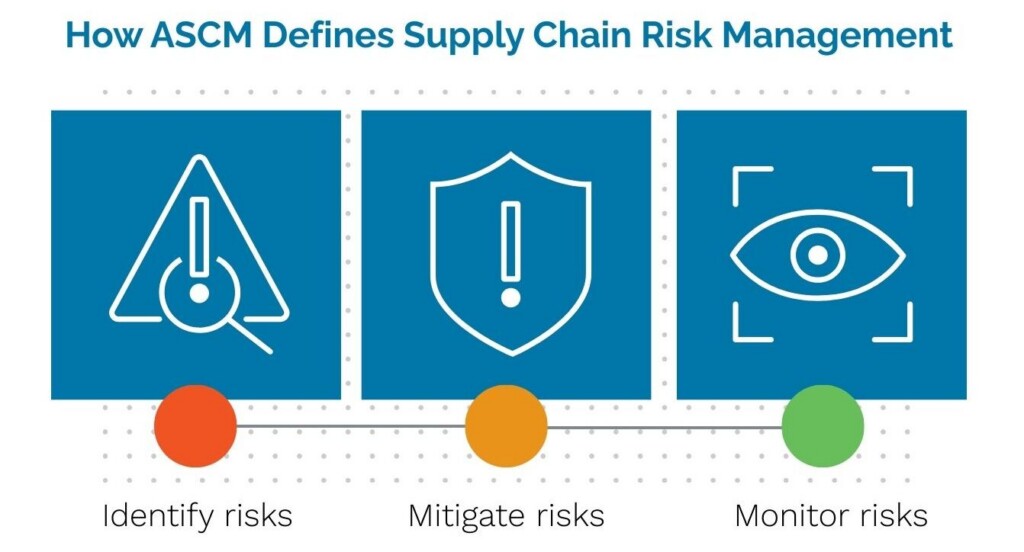
The Association of Supply Chain Management (ASCM) defines supply chain risk management as the “identification, assessment, and mitigation of potential supply chain disruptions” with the goal of minimizing the impacts of supply chain risk on overall supply chain performance. 
graphic showing the 3 phases of supply chain risk management and the value of supply chain risk management is achieved

Figure 1: The ASCM recommends a three-stage approach to supply chain risk management 

As the ASCM notes, there are three phases in supply chain risk management: 

  • Identifying supply chain risks to know where you’re exposed. 
  • Mitigating the impact of potential threats 
  • Monitoring the supply chain to ensure the threat has been effectively addressed 

For years, the conversation around supply chain risk focused on building resilience through redundancy. Adding more buffer stock, or dual sourcing goods may protect production schedules, but at a cost – excess safety stock ties up working capital. Redundancy is expensive. 

Unfortunately, the opposite is also true: doing nothing is expensive.  

If you have no strategy in place to deal with supply chain risk, you are at the mercy of an unforgiving market. Disruptive events can trigger expensive firefighting. Expedited freight charges pile up. Lost revenue from stockouts mounts. 

In either scenario, you are likely to have an uncomfortable conversation with your CFO. 

In simple terms, SCRM is about knowing what could go wrong, understanding what it would cost you, and acting before it does. 
The 2026 Annual Supply Chain Risk Report

Get insight into 2026’s most disruptive supply chain risks and strategies to mitigate them. 

Get the report

Resilience at All Costs vs the Cost of Resilience  

After the many disruptive incidents in recent years, many companies had a “resilience at all costs” mindset. This is now shifting to a “cost of resilience” paradigm, demanding balance between financial sustainability and operational agility. 

You cannot afford to build costly buffers across your entire supply base. Every dollar spent on safety stock, dual sourcing, or expedited freight must be justified with a clear return on investment. 

Nor should you try and tackle supply chain risk as an abstract concept. Therefore, it is important to have a clear vision of the business outcome you want to achieve and why this is a goal.

Supply Chain Risk Assessment 

You need to undertake your supply chain risk assessment in terms of its direct impact on operations. For example: A critical supplier that frequently misses delivery deadlines causing production stoppages and lost sales. 

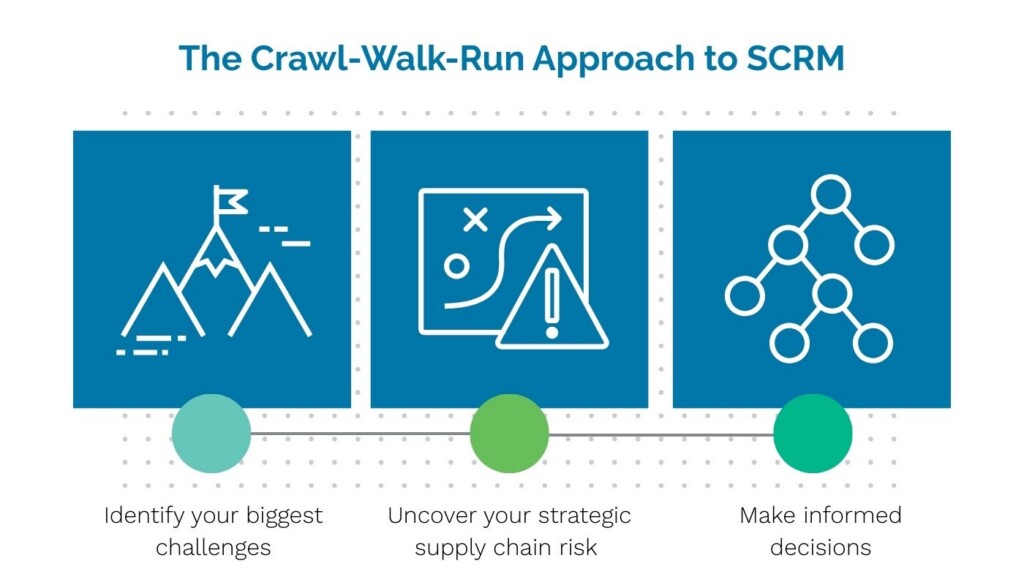
Embarking on a SCRM journey does not require a big bang approach. In fact, most companies follow a crawl-walk-run model.  

Firstly, you start by focusing on your highest-impact use cases.  

Secondly, instead of applying a blanket approach to risk mitigation, you can strategically de-risk your supply chain. This is where predictive analytics and targeted risk intelligence become invaluable. 

Modern supply chain risk management solutions allow you to identify precisely which suppliers, materials, and geographies require protection. You can quantify your risk exposure in financial terms. These include potential revenue loss, margin impact, and recovery costs.  

Finally, this data-driven approach enables you to make informed tradeoff decisions. You optimize your working capital; strategically reduce safety stock where risk is low; and protect your margins where the probability of disruption is high.  

This approach allows you to demonstrate quick wins that build momentum.  

graphic showing the phased implementation of scrm solutions showing how to get to the value of supply chain risk management


Figure 2: A phased approach to supply chain risk management can help you tackle your biggest pain points to derive value quicker 

First Mover Advantage 

SCRM solutions offer more than managing and mitigating risk. Leading companies use SCRM for strategic differentiation and growth by being able to effectively respond while the competition is scrambling.  

As Sun Tzu put it: “In the midst of chaos, there is also opportunity.” 

Consider an event that impacts multiple companies, such as a hurricane or a port strike. In such a case, you and your competitors are in a race to acquire the same limited capacity. This could be alternative transportation, manufacturing slots, or raw materials.  

When a disruption occurs, speed is everything.  

McKinsey & Company found that most companies take about 2 weeks to plan a response to supply chain disruptions. Supply chain risk management can and should give you the ability to move faster than your competition. 

If you can move faster to secure that capacity, you shorten your own recovery time. Equally important, this gives you a competitive advantage and the opportunity to increase your market share. 

Examples of SCRM Value 

Supply chain risk management solutions should not be thought of as a type of “insurance” against disruption. Instead, they should deliver intelligence that drives tangible business outcomes, such as protecting margins, optimizing network design, and enabling proactive sourcing decisions. 

Here are some ways that SCRM solutions drive value: 

Location Incident Assessments 

Early warning risk alerts regarding incidents at a supplier location, distribution hub or other facility allow companies to understand the duration, severity, and context of an active or expected disruptive risk event. This means they can take appropriate action to address the event.  

Value  

First mover advantage reduces expedite costs, avoids production outages, and allows you to correctly allocate inventory for Sales and Operations plans. 

Lane or Shipment Risk  

SCRM solutions can monitor in-transit inventory for risks that could cause delays in delivery or product damage and loss. They can also help you see potential disruptions on lanes when planning shipment routes and modes. This allows you to organize remediation and response and determine the best course of action at the earliest possible time.  

Value  

By monitoring shipment and lane risk, companies can increase (OTIF) delivery rates, improve customer service, and reduce unplanned expedited freight costs. 

Supplier Risk Scoring 

It is possible to assess how vulnerable your suppliers are to different types of external risks. Examples include natural disasters, civil unrest, child labor, and more. This scoring supports supplier selection, category management, and network planning. Proactive assessment allows you to determine where you need to de-risk your operations by reducing dependency on high-risk suppliers. 

Value  

Supplier risk scoring reduces the likelihood of supply interruptions that directly impact production volumes, customer service levels and revenue. 

These are just three examples. There are many more. What they all have in common is that they help companies protect profits by reducing costs. As Benjamin Franklin supposedly said: “A penny saved is a penny earned.”

Your CFO would undoubtedly agree. In supply chain, pennies saved via risk avoidance often translates into millions protected in revenue and margin. 

The 2026 Annual Supply Chain Risk Report

Get insight into 2026’s most disruptive supply chain risks and strategies to mitigate them. 

Get the report

Share this post