

What could go wrong in your supply chain? Natural disasters, extreme weather, material shortages, port congestion, supplier bankruptcies, strikes, fires, child-labor scandals—the list is long. And the sheer number of risks is only part of the problem.
As companies seek to take a more proactive approach to supply chain risk management, risk diversity presents a major challenge. Effective management requires an organization to determine how much risk it is willing to tolerate in its operations and where it will deploy its resources to monitor and mitigate those risks. That’s difficult to do when the probability, scale, duration, and impact of risk effects are so different.
Supply Chain Risk Scoring Principles
The quest for a common language to describe multidimensional risks has driven the development of sophisticated risk-scoring systems. This is an emerging field in supply chain risk management, and there is yet no standard approach. Nevertheless, the principles of risk scoring are relatively straightforward.
- Risks of all types are rated on a common numerical scale, with zero representing no known incidence of risk and the highest number on the scale representing the highest known severity of that risk.
- The scale is chosen so that it permits sufficient granularity to track subtle changes in risk profile over time and between locations. Since risk scores can only ever be estimates, however, scoring systems should not pretend to offer an excessively high degree of precision. At Everstream Analytics, we rate risks on a 0 to 25 scale.
- Risk scores are calculated at an appropriate level to support strategic and tactical supply chain decision-making. That could vary from the level of individual production sites and supply chain nodes all the way to whole-country or region risks.
Supply Chain Risk Scoring Applications
Risk scoring transforms an organization’s ability to visualize risks across its network and simplifies the challenge of evaluating the cumulative effect of multiple risks. Everstream customers use a range of visualization and analysis tools to derive rapid insights from risk scores:
- Risk scores can be assigned to specific events, such as forthcoming strike action at a port, a forecast storm, or a sudden increase in border wait times. Linked to an effective alerting system, scores help supply chain and logistics teams prioritize their responses, especially in big, complex supply networks.
- Risk heat maps indicate potential trouble spots for specific risk types.
- Weighted composite scores provide an at-a-glance estimate of current risk levels across the network. That helps supply chain management teams focus their attention on where it matters most, and shows supply chain leaders where their teams may be coming under pressure.
- By setting thresholds and alerts for individual and aggregate risk scores, teams can take proactive action to prevent problems by increased monitoring or adapting their planning.
Benefits of Quantifying Supply Chain Risk
With risk-scoring mechanisms in place, operations can begin to realize benefits almost immediately. From tactical wins to strategic support, risk scoring can help leaders prioritize action, deploy resources, and smooth communications.
Links supply chain risk to specific assets
A severe earthquake might not be an issue for a supplier with a building constructed for earthquake resilience. It will be an issue for any semiconductor plant, where even minor tremors disrupt the nanometer-focused production process.
Establishes a baseline for communications
Hurricanes might be perceived differently for people living in different regions. If you are in the region and have experienced hurricanes in the past, you might underreact to the situation. But a person seeing a hurricane unfold for the first time might overreact. Scoring provides a realistic baseline across teams and cultures.
Can be tailored to different users
By adding individualized weighting users can create their perfect risk setup for their specific supplier group. Maybe you want a record of heavy rain, but it should not raise your risk score. You won’t be overloaded with alerts, but you can reference the record if faulty electronic parts arrive that are wet due to bad handling in logistics.
Helps managers prioritize action
In the event of an alert for a massive disruption, (e.g. volcano eruption) many suppliers may be affected at the same time. Which one should you call first? Risk scores reveal the potential impact, which helps establish priority.
Simplifies a complicated topic
There are many risks out there, and it can be difficult to weigh port congestion compared to a pandemic outbreak. Risk scoring can establish a standard which enables sophisticated dashboarding. For example, once risk scoring is implemented, a dashboard can generate a single number encompassing network supply chain health at any given moment. That simplicity can help contextualize the situation for supply chain professionals not working on risks daily.
In addition to these tactical applications and benefits of risk scores, companies can also use risk scoring to inform their strategic planning. That might include supplier evaluation during procurement, the selection of locations for new production or distribution facilities, or the choice of transport modes and routes.

Figure 1: Supply chain risk scoring informs all stages of the supplier lifecycle, from research and onboarding to ending the relationship.
Tactical Supply Chain Risk Scoring Elements
Tactical risk scores are built using a wide range of data sources. That can include historical data on weather patterns, natural disasters, and geopolitical events. It can include public and proprietary data sets on supply-chain-related events such as transport disruptions, customs delays, or cargo theft. And it can include real-time monitoring of media reports, on-ground information provided by analysts, researchers, and social media content.
Contextualizing acute supply chain risks
Supply chain teams have specific needs from risk data. While a government department or aid agency might be interested in the overall risk that a region will be affected by a natural disaster or social unrest, companies want to understand the exposure of specific sites in their networks.
To ensure that risk scores are relevant for supply chain management, the underlying data must be sufficiently granular. That means that flood risk data, for example, should be able to differentiate risks at the level of individual location addresses.
Where risks might affect suppliers, sub-tier suppliers, transport lanes, or large areas such as ports or industrial developments, accurate geofencing algorithms are needed to ensure that only relevant data is incorporated into the score.
Risk scores must also be timely. An unexpected event, such as a flood or terrorist attack, can suddenly convert a low-risk region into a high-risk one. The best supply chain risk management systems continually scan for such events. The system then updates the tactical risk scores based on pre-programmed user preferences, which triggers alerts for relevant stakeholders. And of course it updates in near-real-time when situations change.
Tailoring risks to user preferences
Supply chain risks are everywhere and can come in many different forms. They might be relevant to many types of users, like a professional working in procurement or in logistics, a supply chain planner, or an executive-level manager.
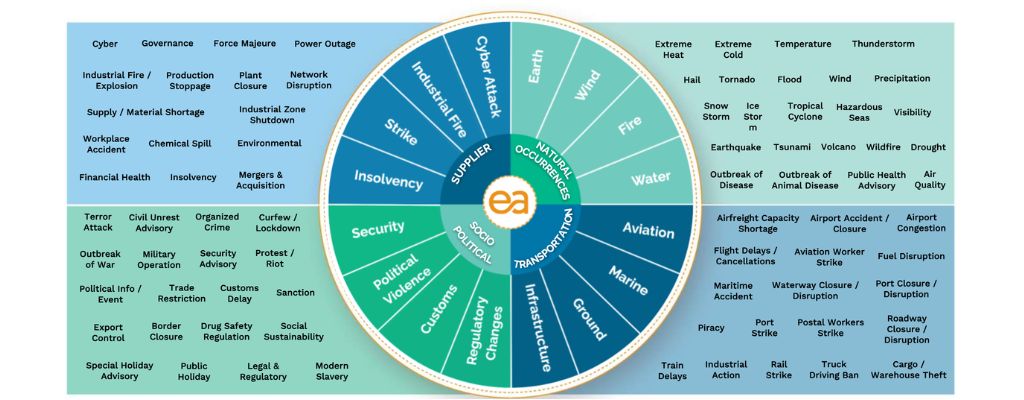
Figure 2: A wide range of supply chain risk alerts can be aligned with planning, sourcing, manufacturing, and delivery objectives.
The interesting thing is that each of these users might see a risk in a different light. A five-day port congestion is a major threat to a logistics professional. But it is only indicative news for a supply chain planner who will simply readjust plans for even larger delays. Risk scoring helps put the news into context for specific users. Each can adjust risk-scoring models to their specific preference, which provides a more seamless experience in terms of user interface and further actionability.
Tactical supply chain risk scoring and relevance
Instead of relying on location-based or media-monitoring systems, today’s SCRM leaders work with more sophisticated context engines to avoid alert fatigue. A state-of-the-art context engine understands the type of alert, how to filter it, and the best manner of delivery, which all combine to create user-based relevance. This is a fundamental basis for any effective tactical SCRM program and effective risk scoring.
However, risk scoring is also part of the solution. To go back to the five-day port congestion example, past solutions would filter alerts for users who have selected the port name and then automatically send an alert. That means the logistic professional who has selected that port name would receive the alert, but the supply chain planner who isn’t monitoring that port would have limited visibility to avoid too many alerts in his mailbox.
With further refined risk scoring, the supply chain planner can instead choose to slightly increase the risk score of an individual port and thus not get the alert. He still can draw the alert into his dashboard and monitor it in the solution through a well-thought-through UI catered to risk scores. But he avoids alert fatigue while still maintaining full visibility of a potentially escalating situation.