

This week’s supply chain risk news
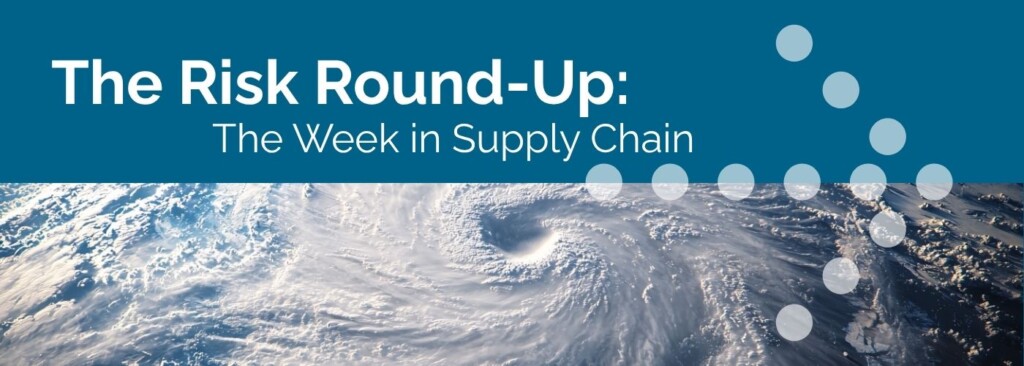
After cutting across the Philippines, Typhoon Fung-wong calmed before reaching Taiwan
Dozens of people have been killed and more than a million forced to evacuate as Typhoon Fung-wong swept across the Philippines before turning toward Taiwan in recent days.
The storm—which at its peak reportedly had winds up to 115 mph (185 km/h) and reached a diameter of some 1,800 kilometers, or over a thousand miles—came just a week after Typhoon Kalmaegi left more than 200 dead in the Philippines and later crashed into Vietnam.
In addition to the catastrophic human toll, the two typhoons have knocked out power to entire provinces and shuttered numerous airports and ports in the region.
It takes a little time to pull out of a nosedive
U.S. President Donald Trump has now signed legislation to reopen the federal government after the longest shutdown in the country’s history. But don’t expect American aviation to bounce back right away. Flight schedules, which had been throttled back because of the shutdown, will take several days to return to normal.
As many have noted, air traffic controllers were already in short supply and working tough hours before the shutdown, which then obliged them to keep showing up for work without pay. Unsurprisingly, attendance took a hit.
That prompted federal officials to cancel more than 10 thousand flights in recent days to ease pressure amid staffing shortages. Attendance has since improved somewhat, and deeper cuts are no longer expected. However, it may take the better part of a week for things to stabilize. Perhaps just in time for Thanksgiving, one of the year’s busiest travel times.
We have more background details in our Risk Center.
The handwringing over Chinese rare earths isn’t going away
China has agreed to ease export restrictions on rare earths and other materials that are key to cutting-edge technology. However, Beijing is reportedly planning to restrict shipments to companies that make military equipment. China’s new “validated end user” system was first reported in the Wall Street Journal, which says the system would be modeled after U.S. laws and procedures.
“If strictly implemented, the system could make importing certain Chinese materials more difficult for automotive and aerospace companies that have both civilian and defense clients,” the story notes, while cautioning that the plan could still change.
Meanwhile, Europe’s top processor of rare earths, Solvay, has inked two deals to supply rare earths to U.S. magnet companies. Both the U.S. and especially Europe are scrambling to resuscitate their rare earth industries, which were outsourced to China decades ago, as the New York Times reports: “About 98 percent of the bloc’s rare earth imports come from China, versus 80 percent for the United States.”
It’s an interesting challenge. Not least because, as we’ve written before, it’s not the type of industry you can spin back up overnight.
The chips must flow, part II
Modern cars are full of chips, many of which are produced in China. If the Chinese government halts delivery of some of those chips—as it did last month—then awkwardness ensues for carmakers. But some relief may be on the horizon.
The row started in late September. The Dutch government seized control of a Chinese-owned chipmaker in the Netherlands using a Cold War-era emergency law. China responded by clamping down on chip exports. This prompted numerous car companies to warn the result could be a huge supply chain debacle. Carmakers like Volkswagen, Nissan, and Honda have since felt direct impacts. Though some could turn to stockpiles or alternative supplies, others have faced production stoppages due to the shortage.
A few weeks on, though, reports suggest the two sides are talking it out. Beijing is expected to let exports resume, thus easing the crisis. While Everstream clients have been getting more details and recommendations as things unfold, we have the highlights in our Risk Center.
Risks are everywhere in your supply chain, but how well can you see them?
How much do you know about what’s going on with products in the supply chains that matter to you? Seeing into this world—and the stages from sourcing raw materials to product delivery—is what’s known as supply chain visibility. It’s foundational to risk management because it lets businesses spot and deal with potential disruptions early and better handle uncertainty.
Supply chain visibility is crucial to proactively heading off disruptions from, say, shifting tariff policies, port strikes, or severe weather events, to give some recent examples. It can also strengthen supplier relationships and make sourcing more reliable. But it’s not easy; it involves sifting through a great deal of data, and may hinge on information that’s hard to get.
And while you might not need to know a ton about all of your suppliers’ suppliers, you particularly want visibility for those that make critical components or goods you can’t easily source elsewhere. The more you know about the potential risks here, after all, the better you can manage them. We discuss supply chain visibility more on our blog.
Other stories we’re reading and monitoring
The Suez Canal makes it possible for ships to shortcut between the Red Sea and the Mediterranean and skip the long trip around Africa, but traffic through it fell off sharply in 2024 amid the threat of attacks. Things have somewhat improved this year—and the ceasefire in Gaza might help.
The high explosive TNT costs a lot more than it used to resulting in more expensive construction and infrastructure projects, experts say—and right now there’s a shortage due to the war in Ukraine. That’s prompted the U.S. to launch domestic TNT production for the first time in decades, though a new facility won’t be online until 2028.
In addition to disruptions in aluminum and chips, another complication recently facing the car industry has been protests by Mexican farmers demanding fairer corn prices. Enough parked tractors reportedly blocked enough trucks that manufacturers like Audi, GM, Nissan and Mazda had to pause plant operations.