


At 11:24 local time on July 30, a magnitude 8.8 earthquake occurred 126 kilometers (78 miles) east-southeast of Petropavlovsk-Kamchatskiy, Kamchatka Krai, Russian Federation, becoming the largest earthquake event to occur since 2011’s magnitude 9.0 earthquake in Tohoku, Japan.
Following the earthquake, tsunami waves of up to 4 meters (13 feet) in height were recorded in parts of Kamchatka and the Elizovsky district, with damage to several buildings reported. Authorities proceeded to issue evacuation orders for people from Severo-Kurilsk, Elizovsky, and Kamchatka. In the hours since the earthquake struck, over 100 aftershocks ranging in magnitudes of 4.4 to 6.9 have been recorded offshore near Russia’s Kamchatka Peninsula.
Tsunami advisories and evacuations were also issued for the coasts of Russia, Japan, the United States, Peru, Ecuador, Chile, French Polynesia, the Philippines, and Indonesia. The 8.8 magnitude earthquake further led to the eruption of the Klyuchevskoy Volcano on the Kamchatka peninsula. Ash plumes reportedly rose up to 3 kilometers above sea level.
In Japan, tsunami warnings were issued along the Pacific coast, from Hokkaido to Wakayama Prefecture, with authorities warning of tsunami waves of up to 3 meters (10 feet) in height. Later in the day, tsunami waves of up to .5 meters (1.6 feet) were recorded along the coast of Hokkaido, Japan, prompting about 2 million people to evacuate across 229 municipalities.
In the United States, the Alaska Aleutian Islands and the western coastal regions of California, Oregon, Washington, and Hawaii were placed on tsunami alerts. Waves of up to 1.7 meters (5.6 feet) were recorded in parts of Hawaii, United States, while waves of up to 1.1 meters (3.6 feet) were recorded in California and up to 0.5 meters (1.6 feet) in British Columbia, Canada.
In other countries such as Chile, Peru, Ecuador, and Indonesia, coastal populations were ordered to move to higher ground due to the risk of waves reaching up to 3 meters (9.8 feet) in some locations. No major damages have been reported in these countries, though emergency protocols were activated. Monitoring continues for all the affected regions for potential aftershocks and secondary waves.
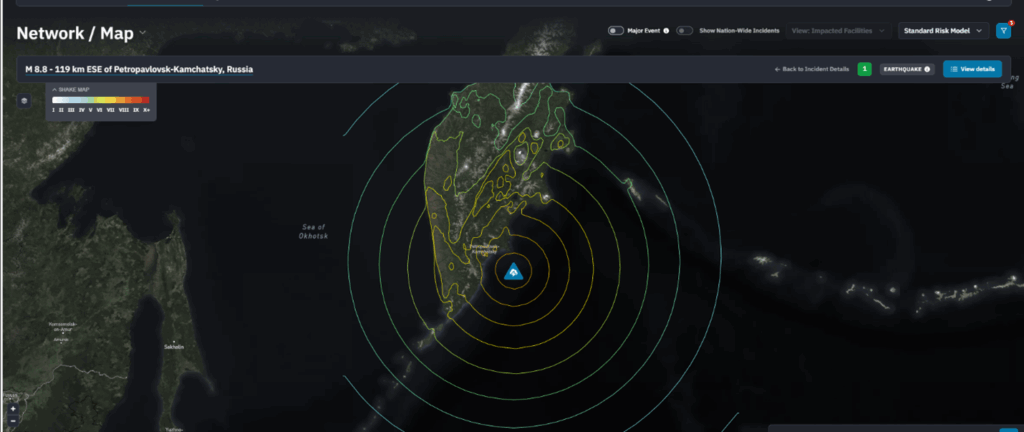
Map 1: Earthquake epicenter and shakemap (source: Everstream Analytics)
Varying tsunami threats disrupt logistics across Pacific coastal locations
In Japan, multiple ports across the country were reportedly affected after tsunami alerts were issued. The Port of Nagoya suspended operations, halting activities at container terminals and conventional berths. Japan Freight Railway Company announced freight train delays in Shizouka, Kanto, Tohoku, and Hokkaido. In the aviation sector, Sendai Airport in Miyagi, Japan closed its runway and canceled all flights, with several airlines, including Japan Airlines and Nippon Airways, suspending flights to and from the airport. A total of 16 flights were canceled at the time of reporting, and many others were diverted.
Several expressways were also reportedly closed, affecting transportation in parts of Japan. In Hokkaido, the Dō-Ō Expressway and the Doto Expressway were closed at several points. In Miyagi, Sendai Higashibu Road and Joban Expressway were shut down. In Chiba Prefecture, the Kujukuri Road and National Highways 6 and 45 along the Tohoku coast were closed in multiple locations. Logistics and parcel delivery companies, Yamato Transport Co., Ltd and Sagawa Express Co., Ltd halted all operations between Hokkaido and Wakayama Prefecture. Japan Post suspended operations at 455 post offices located between Hokkaido and Okinawa, causing disruptions to postal operations across the country.
In the United States, Alaska Airlines, Southwest Airlines, Hawaiian Airlines, Delta Airlines, and American Airlines canceled flights to and from Hawaii after tsunami warnings were issued. Flight delays and cancellations are anticipated at Daniel K. Inouye International Airport, Lihue Airport, Kona International Airport at Keāhole, and Kahului Airport. The Port of Honolulu ordered the evacuation of all commercial vessels from harbors across the Hawaiian Islands. All ports were closed to inbound vessel traffic and ships were required to stay offshore until further notice. Additionally, the Port of Los Angeles, California cancelled all shifts at APM Terminals.
Following the evacuation of locals from coastal areas of seven regions of Chile including Arica and Parinacota, Tarapacá, Antofagasta, Atacama, Coquimbo, Valparaíso, and O’Higgins, all Chilean ports have been closed until further notice. In Peru, authorities further closed over 65 local ports across five regions, including the Port of Paita. In Colombia, the National Unit for Disaster Risk Management has downgraded a tsunami alert for the Pacific coast to an advisory; however, maritime traffic has also been restricted.
Tsunami threats disrupt production operations in coastal Japan
The tsunami threat in Japan further caused widespread factory disruptions in coastal areas of Hokkaido, Miyagi, Kanagawa, Okayama, Fukushima, and Ibaraki prefecture. Factories reportedly evacuated workers from the plants, halting operations for an unknown duration.
Several automotive factories in Japan including Toyota Motor Corporation and Mitsubishi Motor Company suspended operations and evacuated employees. Some paper, industrial equipment, chemical, and petroleum manufacturing industries also reported similar disruptions.
Everstream clients are receiving more detailed insights and recommendations about this risk.
Don’t miss key supply chain risk updates! Subscribe now to get supply chain news, weather updates, forecasts, and other insights.