


This week’s supply chain risk news
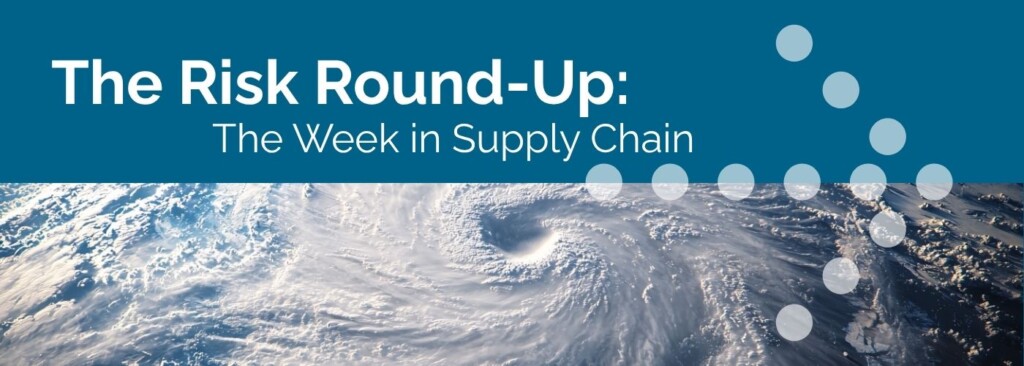
The storm that halted Asia’s industrial heart
This year’s most powerful storm, Super Typhoon Ragasa, didn’t just bring record-breaking winds – it brought one of the world’s most critical manufacturing and shipping hubs to a standstill. As Ragasa carved a path through the Philippines and slammed into Southern China, millions were evacuated, and authorities were forced to take drastic measures.
Major ports, including Hong Kong and Shenzhen, fell silent. Factories for global giants like Foxconn went dark. Airports, bridges, and rail lines were shut down across more than a dozen cities. Now, with an estimated 30,000 tons of cargo backlogged, the ripple effects on global supply chains are just beginning to surface. We have the details in our Risk Center post.
For Chinese goods headed to Europe, the journey got longer
Around 90 percent of Chinese rail freight bound for the EU travels along the China-Europe Railway Express, which passes from Belarus into Poland. This month, Poland closed that border while Belarus hosted military drills alongside Russian forces. When the drills ended five days later, Poland opted not to reopen it until midnight on Thursday morning, 24 September.
The closures affected all truck crossings and rail freight passages. Transit delays piled up for machinery, cars, electronics, and perishable goods like pharmaceuticals and food.
As our Risk Center notes, there are other border crossings in Latvia and Lithuania where Chinese goods could head to European destinations. Those routes quickly became congested. For goods from China’s inland western provinces, where there’s no easy seaport access, the impacts will likely be more severe. Thus, it affects products like electric vehicles, lithium batteries, and solar panels.
Among the people this is a headache for were thousands of Polish and Belarusian truck drivers stuck on the wrong side of the border and unable to return home. Any snacks they packed are, presumably, long gone.
Washington and Beijing are still negotiating, but trade relations aren’t exactly cozy
After progress this month between the U.S. and China on the future of TikTok, their next round of talks could turn to export controls on critical rare earth magnets. In the meantime, trade between the two countries has hardly kept to the status quo. September saw new restrictions, like one from the U.S. targeting trucks and drones from China, and new investigations.
Specifically, China is looking into analog chips from the U.S. for devices like hearing aids, temperature sensors, and wireless routers. At issue is whether those chips have been dumped at artificially low prices. This comes after China already passed anti-dumping tariffs on U.S. optical fibers earlier this month. Another investigation concerns whether the U.S. discriminated against China with rules on exporting chip-related products. There are also antitrust questions for the U.S. chipmaker Nvidia.
This background suggests bilateral tensions between the two countries will remain high. We have more context in our Risk Center, along with details about other potential tariffs and trade restrictions, like recent pressure directed at China and India for importing Russian oil.
Choppy waters are in store for maritime shipping, a new UN report warns
“Not since the closure of the Suez Canal in 1967 have we witnessed such sustained disruption to the arteries of global commerce. Ships that once transited the Red Sea in days now sail for weeks around the Cape of Good Hope. Freight rates that were relatively stable for years now swing wildly from month to month. Supply chains we thought were resilient have proven fragile,” a new UN Trade and Development report begins.
It expects seaborne trade to stall this year, growing just half a percent, before averaging around 2 percent over the next few years. Tariffs are a factor here, but hardly the only consideration. Meanwhile, the average container ship waits hours longer in port compared to a decade ago. This underscores the need for infrastructure to adapt. And high transport costs, the report notes, can unfairly affect poorer countries, particularly on small islands.
If there’s a silver lining in all this, it’s that with so much upheaval—so much that must be rethought, retooled, or built anew—it’s possible some positive changes can emerge. Getting there from here, though, may not be a smooth ride.
After a busy few months for truckers, August was different
Earlier this year, a lot of cargo shippers were hustling to move inventory along before new tariffs took hold. But with that surge of frontloading now quieting down, long haul freight volumes shrank in August.
That’s true for flatbeds that haul large crates or other vehicles, and for refrigerated units, otherwise known as reefers. Volumes for both were down 6 percent from the prior month. Dry vans, which haul appliances, electronics, non-perishable food, and almost anything else that will fit on a palette, saw even steeper declines, down by 8 percent. And spot rates ticked down for all three.
Experts say that’s a sign shippers achieved what they set out to do by getting back-to-school supplies and holiday products closer to their destinations faster.
While there’s a lot of uncertainty looking forward, it’s possible the lower rates for moving freight stay down at least a little while longer, as carriers maneuver to secure contracts for next year.
There are seven types of logistics risk. How predictable are they?
When a shipment arrives on time, it’s almost unremarkable. When it doesn’t, it costs you time, money, and possibly sanity. You’d prefer to sidestep this problem whenever possible, whether it’s due to severe weather, congestion at a key port, or even a carrier going broke.
Fortunately, many of these risks are predictable—or lead to cascading disruptions in predictable ways. These logistics risks tend to fit into seven categories, from cyberattacks to physical infrastructure risks like bridge collapses, as we discuss on our blog. Getting ahead of them can be extremely worthwhile.
To give one example, you can often anticipate labor disputes and strikes by watching negotiations and knowing when contracts expire. While it’s hardly surprising that a port or driver strike can hobble deliveries and drive up demand for alternatives, having a strategy for mitigation ready might make all the difference.
Crucially, when you understand these seven risk types, you can manage them. That means saving time wrangling last-minute solutions, and saving money for expedited shipping, late fees, lost products, and so on. It might just save you some precious sanity, too.